












Article
Design processes, simulation and technical effect: decision T 0799/24 clarifies the requirements for patentability at the EPO
T0799/24 “JFESteel”: an explicit manufacturing step is not mandatory to provide a technical effect by design methods… when a claim implies a future use on a physical object
The most significant decision regarding the patentability of inventions pertaining to simulation and design at the European Patent Office (EPO) is without doubt decision G1/19.
The decision G1/19 recalls that, pursuant to the well-established “Comvik approach”, features relative to simulation shall be taken into account for the assessment of inventive step only if they solve a technical problem and further state that “a computer-implemented simulation of a technical system or process that is claimed as such can, for the purpose of assessing inventive step, solve a technical problem by producing a technical effect going beyond the simulation's implementation on a computer”.
The G1/19 decision however leaves many questions open, one of them being the level of link required with a manufactured product to obtain such an effect for a design method claim, and in particular whether an explicit step of manufacturing is necessary to obtain such an effect for a design method claim.
G1/19 indeed indicates, in its point 134, that including a manufacturing step process would be “of course” an argument in favour of patentability according to the COMVIK approach, but does not present the inclusion of such manufacturing step as an absolute requirement for features of a design method to contribute to the provision of a technical effect. G1/19 also states, in point 124, that technical effects relying to a future use of simulation or design results (typically in case a manufacturing step would not be included in a design claim) must be at least implicitly implied in the claim.
The question of whether or not to provide a manufacturing step, and if not which features should be inserted to ensure that a technical effect is obtained, is of paramount importance for applicant. Indeed, an explicit inclusion in a claim of a manufacturing step would limit the scope of the claim to a succession of design, then manufacture, and could lead to divided infringement, where a claim would encompass both the design steps, and manufacturing step, which would be reproduced by distinct entities.
The decision T0799/24 “JFESteel”, rendered by the Board of Appeal 3.5.07 of the EPO, and published November 7, 2025, provides an example where the provision of a technical effect of a design method was demonstrated without an explicit manufacturing step.
The aim of the invention was to provide an analysis apparatus for determining an optimal location of an additional welded point to be added to a portion to join a part to an assembly of parts in consideration of the load acting on the automotive body and of the inertia force acting on a fitting or lid component of the automobile during driving (paragraph [0014] of the description as filed).
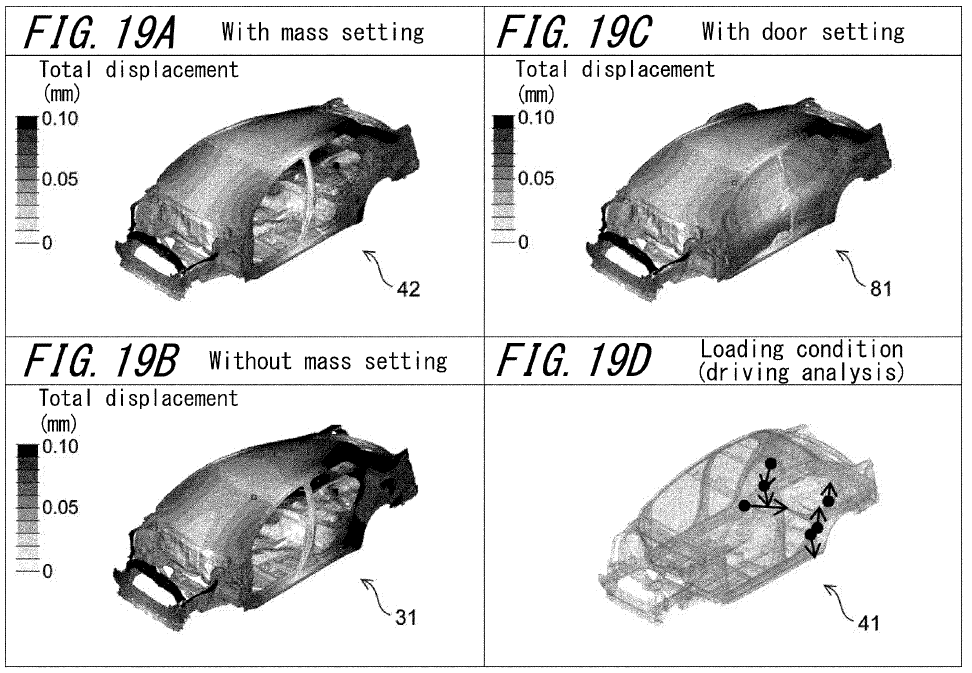
The figure 19A to 19D for example show calculations performed to an automobile body to provide locations of additional welding points, shown in figure 19D:
Claim 1 of the main request reads as follows (as presented by the Board of Appeal):
(a) "An analysis apparatus (1) of optimizing a joint location of an automotive body in order to improve the performance such as the stiffness of an automotive body during driving,
(b) using an automotive body frame model (31)comprising multiple parts formed by at least one of a shell element or a solid element and a welded point (33) or a welded location to join the multiple parts as assemblies of parts,
(c) to perform an optimization analysis of spotwelding or continuous welding used for joining the assemblies of parts,
comprising:
(d) an automobile model generation unit (15) that generates an automobile model (61) by joining the automotive body frame model (31) to a chassis model (51);
(e) a driving analysis unit (17) that performs a driving analysis of the automobile model (61) to acquire at least one of a load or displacement generated at a joining portion to the chassis model (51) on the automotive body frame model (31) during driving,
wherein
(f) driving conditions set in the driving analysis unit (17) include driving and steering of the automobile model (61);
(g) an optimization analysis model generation unit (19) that sets welding candidates of an additional welded point or an additional welded location to be added and joined to the assembly of parts on the automotive body frame model (31), to generate an optimization analysis model as an optimization analysis object;
(h) an optimization analysis condition setting unit (21) that sets optimization analysis conditions for the optimization analysis model; and
(i) an optimization analysis unit (23) that
(i1)performs an optimization analysis on the welding candidates by applying at least one of the load, of which magnitude and direction are different at each joining portion, generated at the joining portion [sic: and] acquired by the driving analysis unit (17) to the optimization analysis model
(i2)to select an additional welded point or an additional welded location that satisfies the optimization analysis conditions from the welding candidates and thereby determine a location of the additional welded point or the additional welded location to be added to the automotive body to improve the stiffness of the automotive body during driving;
and
(j) a display device (3) that displays analysis results of the optimization analysis unit (23) for automotive body designing,
wherein
(k) the optimization analysis model generation unit (19) sets the welding candidates at a predetermined interval between welded points or welded locations preset on each assembly of parts of the automotive body frame model (31); and
(l) in optimization analysis condition setting unit (21), the optimization analysis conditions include objective condition and constraint condition,
(l1)the objective condition including minimizing strain energy and maximizing absorbed energy to minimize generated stress,
(l2)and the constraint condition including making the optimization analysis model have a predetermined stiffness."
The examining division rejected the application based in the reasoning that:
- the hardware and software requirements implied by the invention as claimed in claim 1 were met by a general-purpose computer that would form the closest prior art ;
- the only difference between that closest prior art and the invention as claimed in claim 1 would be the automation of a non-technical simulation method ;
- Such automation would be a straightforward and routine programming operation
The board of Appeal contests the inventive step approach used by the examining division. In particular, the Board states, in point 4.4, that the features wherein the additional welding points are "to be added" to the automotive body to improve its stiffness during driving specifies at least implicitly a further technical used as required by the points 124 and 137 of the decision G1/19.
The board of Appeal then goes on a more classical problem-and solution approach in view of a document D1 forming the closest prior art, and three other documents D2 to D4. The Board of Appeal found out that claim 1 comprised the distinguishing features listed below in view of D1:
DF1 the automobile model (61) is generated by joining the automotive body frame model (31) to a chassis model (51);
DF2 an optimisation analysis unit (23) that performs an optimisation analysis on the welding candidates by applying at least one of the load, of which magnitude and direction are different at each joining portion, generated at the joining portion acquired by the driving analysis unit (17), to select an additional welded point or an additional welded location that satisfies the optimisation analysis conditions from the welding candidates and thereby determine a location of the additional welded point or the additional welded location to be added to the automotive body (to improve the stiffness of the automotive body during driving);
DF3 the driving conditions set in the driving analysis unit (17) include "driving and steering" of the automobile model (61);
DF4 the optimization analysis model generation unit (19) sets the welding candidates at a predetermined interval between welded points or welded locations preset on each assembly of parts of the automotive body frame model (31);
DF5 the objective condition includes minimising strain energy and maximising absorbed energy to minimise generated stress.
The Board and the applicant agreed that the objective technical problem solved by those differences would be "how to design an automotive body in which the stiffness of the automotive body during driving is improved.. The Board then came to the conclusion that, although features DF1, DF3 and DF4 would be rendered obvious by a combination of D1 with the document D2, none of the documents D2 to D4 would render obvious the features DF2 and DF5, wherein:
- Feature DF2 specifies in particular that the load applied has a different magnitude and direction at each joining portion ;
- Feature DF5 specifies that the objective condition set by the optimization analysis condition setting unit includes minimising strain energy and maximising absorbed energy to minimise generated stress.
The Board then discussed again the question whether those distinguishing features would provide, within the whole scope of the claim, a technical effect.
In this respect, the sole provision of the preamble of the claim of a claim "for automotive body designing" was not sufficient, because it lefts open which further steps, technical or not, are performed with the analysis results, a potential further selection of a particular automotive body might also be based on the visual characteristics or appearance of the automotive body. (point 34.1).
On the contrary, the wording of the features wherein:
- A specific automobile body is selected (point 34.1) ;
- An additional welded point or an additional welded location that satisfies the optimization analysis conditions, including maximising absorbed energy, is selected (point 36) ; and
- the additional welded points of which the locations are determined or selected are "to be added to the automotive body" (point 37).
at least implicitly imply a further technical use, as required by the points124 and 137 of the decision G1/19.
Furthermore, those features aimed at optimizing a joint location of an automotive body in order to improve the performance, such as the stiffness of an automotive body during driving, thereby providing a technical effect (point 38). The board further stated that it is implicit that the welding point will be added to the automotive body, which is a physical object even if the automotive body is a prototype (points 43 and 45). The Board of Appeal was also satisfied that the automotive model constituted by the automotive body frame model and the chassis model together with the welded points at the joining portion(s) is considered to reflect an automotive body (as "reality") "accurately enough" as required by the point 111 of the decision G1/19.
In summary, the decision T0799/24 of the Board of Appeal 3.5.07 provides a concrete example of a design method claim where the patentability conditions defined in the decision G1/19 were met without requiring an explicit manufacturing step.
In this example, the Board of Appeal was satisfied that the requirement to solve a technical problem were met, because the claim was related to a specific technical object (the automotive body), the design-related features (placement of the additional of welding) point were directly tied to the provision of a technical effect (maximization of energy absorption), and the claim required that the obtained design would be applied to the technical object, since the welded points where to be added to the automobile body.
The decision T0799/24 thus provides guidance for applicants to draft applications relative to design methods that comply with the technical requirements set out in the decision G1/19, without inserting an explicit manufacturing step, which would be detrimental to the scope of the claim. In particular, the decision T0799/24 showed that, even in absence of an explicit manufacturing step, an unambiguous link with a physical object to provide a technical effect was required.
The decision T0799/24 thus provides a welcome equilibrium between the requirements of providing a technical effect, and the expectation of applicants. The fact that the decision was rendered by the Board of Appeal n° 3.5.07 which is the one that most often deals with the simulation and design applications makes it likely that the open approach followed by the decision T0799/24 may be again used in the future by the Boards of Appeal of the EPO for the assessments of inventions pertaining to design methods, and more generally to simulation methods.















 紹介資料を開く