












Article

Sufficiency of disclosure and Artificial Intelligence: lessons from decision T 0048/24 (EBARA)
One of the key requirements that a European application must fulfill is the criterion of Sufficiency of disclosure, set out in Article 83 EPC : “The European patent application shall disclose the invention in a manner sufficiently clear and complete for it to be carried out by a person skilled in the art.”.
This criterium defines not only a requirement for a patent to be granted, but also a ground for revocation, if the patent is found, during an opposition or nullity proceedings, insufficiently disclosed.
The greatest care must thus be taken, when drafting a patent application, to ensure that the application is sufficiently disclosed.
According to the established jurisprudence of the boards of appeal, an invention is sufficiently disclosed if it can be performed by a person skilled in the art without undue burden in the whole area claimed, using common general knowledge and taking into account further information given in the description of the patent or patent application.
This makes the question of sufficiency of disclosure particularly complex in the field of artificial intelligence, wherein the scope of a claim may encompass a large number of combinations of elements including for example possible models architecture, hyperparameters, types of input and output data, training data, or training methods.
This is the object of the decision T0048/24 (Estimating waste composition/EBARA) of the Board of Appeal 3.5.06 of the EPO, dated November 13th, 2025 and published February the 6th, 2026. This decision is discussed below.
The invention and claim 1
The patent at hand relate to the estimation of the composition of a waste pit. For example, such a composition may be used for determining the heating potential of the waste.
Claim 1 read as follows:
"[M1.1] A device (200) comprising:
[M1.2] a training data generation unit (220) adapted to generate training data associated with a captured image of waste stored in a waste pit;
[M1.3] a model construction unit (230) which is adapted to construct a model by performing learning using the training data; and
[M1.4] an estimation unit (250) which is adapted to input, in the model, data of a new captured image of waste stored in a waste pit, and to obtain a value representing composition of the waste corresponding to the new image."
Concrete examples were not provided in the description of the patent, but a concrete example has been provided in an Annex provided during the opposition proceedings that can be found here.
In the concrete example provided during opposition proceedings, four different labels where provided, depending upon the heating value of waste. Examples of such labelling are provided below:
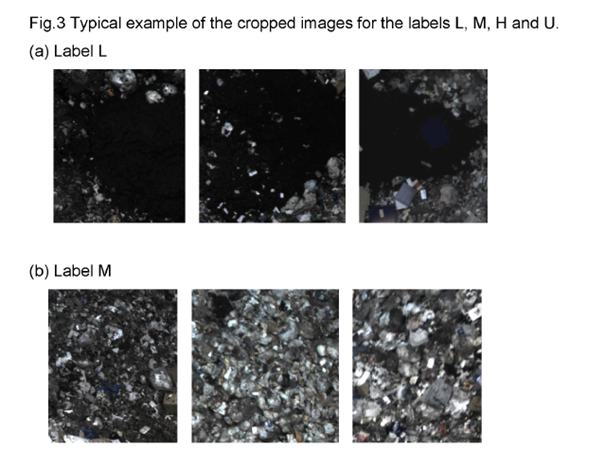
A Convolutional Neural Network (CNN) was then trained to classify images into one of the four labels.
The concrete example provided during the opposition proceedings also comprised many details relative to the training method (e. batch sizes, evolution of accuracy, etc.)
Decision of the Board of Appeal
The Board of Appeal revoked the patent for being insufficiently disclosed, for the reasons listed below.
Lack of provision of a concrete example in the application as filed
First, the Board of Appeal noted (point 3.1) that the invention did not contain a specific example, for example did not disclose any specific combination of certain "data of" captured images and a particular "value representing composition" of the waste in the images, nor does it provide any details on the implementation and training of an exemplary machine learning model, or any information on the achieved accuracy of estimation. In other words, the patent did not contain any concrete, reproducible example of implementation of the invention.
The Board notes that the provision of such an example is not in itself an absolute requirement for sufficient disclosure, provided that the skilled person is otherwise aware of "at least one way" of carrying out the invention, for example, through the generic disclosure in the patent or the common general knowledge It however asserted this could serve as a reference to better understand the invention.
The Board acknowledges that the example provided in the Annex filed by the patent proprietor during the opposition proceedings provides a “very detailed” example of how the invention could be successfully reduced to practice. This additional information however cannot be used for the purpose of the assessment of the sufficiency of disclosure, because it belongs neither to the application as filed, nor to the general knowledge of the person skilled in the art (Point 3.2 of the decision).
Undue burden, and the breadth of the claims
The Board indicates that, even if the detailed example were included in the application as filed, it would still not fulfill the requirement of sufficiency of disclosure because the invention could not be carried out over the whole claimed breadth without undue burden (Point 3.3 of the decision).
More specifically, the Board indicates that the patent in suit teaches the general idea of using machine learning to infer properties of the waste composition that could be relevant for operating and controlling a waste incineration plant from images of the surface of the waste pit, but the disclosure is mostly limited to stating a "result to be achieved", as shown for example in the paragraph [0039] "The model is constructed in such a manner that it outputs a correct output corresponding to a new input when the new input is given".
The Board then evaluates the burden that the skilled person would face to carry out a workable solution over the whole scope of the claim, and in particular notes that :
- there is a wide variety of possible input "data of" a captured image and of conceivable output "values representing composition" involving different precision requirements. There is also a wide variety of types of machine learning models that the person skilled in the art could use , each further characterized by a wide variety of possible parametrizations ;
- the skilled person receives no specific guidance in the patent as to which types of data or machine learning algorithms are more or less promising for achieving the claimed objective, namely the output of different values that "represent" the composition of the waste. The patent leaves it to the skilled person to select and evaluate combinations of input data and machine learning models for different desired outputs ;
- each evaluation represents a considerable effort in itself. Exploring all the possible combinations of the parameters mentioned above would require a comprehensive research program and would place an undue burden on the skilled person.
According to the analysis of the Board, the undue burden does not originate solely from the breadth of the claim or from the fact that each evaluation alone requires some effort. It is rather due to the fact that the skilled person has insufficient information on the relevant criteria for finding workable solutions across the whole breadth of the claim, meaning they would have to try and evaluate each and every possible alternative individually. It also has no guidance from the patent on how to choose a suitable combination from across the claimed breadth to start from. This, according to the Board, reflects the fact that the disclosure in the patent is not proportionate to the breadth of the claim, in the sense that the general principle that the protection obtained with the patent has to be commensurate with the disclosed teaching is not respected.
Selon l'analyse de la Chambre, la charge excessive ne provient pas uniquement de l'étendue de la revendication ni du fait que chaque évaluation requiert un certain effort. Elle résulte plutôt du fait que l'homme du métier ne dispose pas d'informations suffisantes sur les critères pertinents pour trouver des solutions applicables à l'ensemble de la revendication, ce qui l'oblige à évaluer individuellement chaque alternative possible. De plus, le brevet ne lui fournit aucune indication sur la manière de choisir une combinaison appropriée parmi les possibilités revendiquées. La Chambre considère que cela traduit le fait que l’étendue de la description du brevet n'est pas proportionnée à l'étendue de la revendication, impliquant ainsi que le principe général selon lequel la protection obtenue par le brevet doit être proportionnelle à l'enseignement divulgué n'est pas respecté.
Conclusion and Key Takeaways of the decision
The decision provides some interesting findings for applicants, for patent applications in the field of AI to comply with the criterion of sufficiency of disclosure.
Firstly, it should be considered as a good practice to provide, in the application, a concrete example that demonstrates that the invention is workable and may serve as a starting point. Such a concrete example may typically correspond to the current implementation of the invention. The concrete example provided during the opposition proceedings could provide an idea about what to put in such a concrete example. However, it would not be necessary to put in the concrete example the same amount of details, as the Board itself considered the example provided here as “very detailed”.
Even more importantly, the disclosure has to be proportionate to the breadth of the claims. This means that, in order to obtain a valid patent having a large scope, one has to provide guidance as to how to put the invention into practice, in particular if the scope of the claim allows a wide number of combinations of interrelated parameters. In order to avoid sufficiency of disclosure issue, a particular caution shall also be brought regarding the use of vague and imprecise terms that may have a large number of different meanings. When it is adequate to the scope of the protection sought, more precise terms could be considered, at least as fallback positions. By means of example, in the present case:
- “labelling a captured image using at least one label representative of the heating value of the of waste” could have been used instead of “generate training data associated with a captured image” ;
- “training a supervised image classification model using the training data” could have been used instead “construct a model by performing learning using the training data”;
- “input, in the model, a new captured image” could have been used instead of “input, in the model, data of a new captured image”.
Such wordings would have been consistent with the objective of the invention to classify images of waste into different levels of heating value, and would have already limited the combinations to explore by the skilled man. Meanwhile, this would have more clearly distinguished between features that are well known, such as finding a relevant image classification model, and features that are more specific to the invention, such as associating the images with labels representative of the heating value of the waste, the latter features deserving a more detailed description to fulfill the requirement of sufficiency of disclosure.













 紹介資料を開く